

Understanding your audience is one of the most important parts of building a successful product, service, website or marketing campaign.
Businesses often assume they know what customers want based on sales figures, website data or internal opinions. While these insights are useful, they do not always explain why customers behave in a certain way, what frustrates them or what they genuinely value.
This is where design thinking can help.
Design thinking is a human-centred approach to problem-solving. Instead of starting with a business assumption and building around it, design thinking begins with the people who will actually use the product, service or experience.
By understanding customer needs, testing ideas and improving solutions based on real feedback, businesses can make more informed decisions and create experiences that are more relevant to their audience.
Design thinking is a structured approach to solving problems by focusing on user needs.
It is commonly used in areas such as:
The process encourages businesses to understand problems from the customer's perspective before deciding on a solution.
Rather than asking:
“What should we create?”
design thinking starts with:
“What does our audience actually need?”
This shift can lead to better websites, stronger marketing campaigns and more useful products or services.
Businesses sometimes invest in solutions before fully understanding the problem.
For example, a company may redesign its website because it looks outdated, but the real issue may be that customers cannot find important information.
An ecommerce business may add more products when customers are actually struggling with navigation or checkout.
A marketing campaign may generate traffic but fail to convert because the message does not address the audience's main concerns.
Design thinking helps reduce this risk by putting research and user understanding at the beginning of the process.
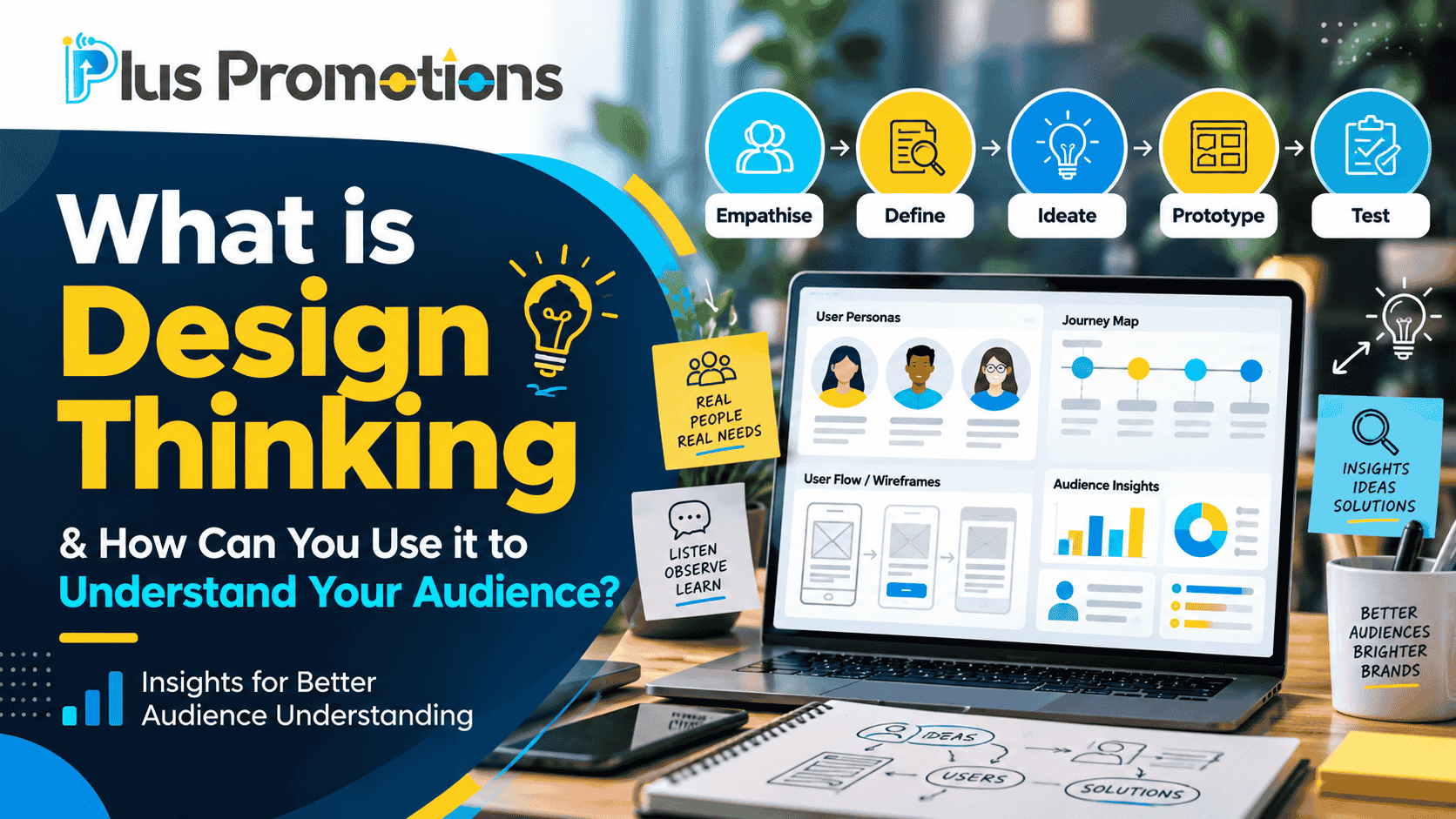
Design thinking is often described through five stages:
The first step is understanding the people you are designing for.
This involves learning about their:
Methods may include interviews, surveys, customer feedback, website analytics, reviews and direct observation.
The objective is to understand the audience as people rather than simply as statistics.
Once you have gathered information, the next stage is identifying the real problem.
For example, a business may initially believe:
“Customers are not buying enough products.”
After research, the actual problem may be:
“Customers are leaving because delivery costs are unclear until checkout.”
A clearly defined problem makes it easier to develop an effective solution.
The ideation stage involves generating possible solutions.
The focus should initially be on exploring different options rather than immediately choosing the safest or most obvious idea.
For example, solutions might include:
The best solution often becomes clearer after several ideas have been considered.
A prototype is a simple version of the proposed solution.
It does not need to be finished or perfect.
For a website, this could be:
Prototyping allows businesses to test ideas before investing heavily in full development.
The final stage involves testing the proposed solution with real users.
Businesses can observe:
The results can then be used to refine the solution.
Design thinking is therefore not always a straight line. Businesses may move between stages several times as they learn more.
Design thinking encourages businesses to move beyond assumptions.
Instead of relying only on demographic information such as age, location or occupation, it focuses on how people think and behave.
This can help businesses understand questions such as:
These insights can improve both marketing and website performance.
Customer interviews are one of the most useful design-thinking research methods.
Rather than asking only whether customers like a product or website, ask questions that explore their experience.
For example:
Open-ended questions often reveal insights that standard analytics cannot show.
Customer reviews, support enquiries and feedback forms can reveal recurring problems.
Look for patterns.
If multiple customers mention the same difficulty, it may indicate a wider experience issue.
Feedback can also show what customers value most.
For example, customers may repeatedly mention:
These insights can influence both website design and marketing messages.
Analytics can support design-thinking research by showing what users actually do.
Useful data may include:
Analytics can show where a problem exists.
Customer research can then help explain why it is happening.
Combining qualitative and quantitative information usually provides a more complete understanding of the audience.
Customer personas can help teams visualise different audience groups.
However, they should be based on real information rather than stereotypes.
A useful persona may include:
The purpose is not to create fictional characters for their own sake.
Personas should help teams make better decisions about content, design and communication.
Customer journey mapping shows the different steps someone takes before, during and after interacting with a business.
This might include:
At each stage, businesses can identify potential problems or opportunities.
For example, a customer might discover a company through Google but then struggle to find pricing information on the website.
Design thinking helps identify where the experience breaks down.
Website design is one of the clearest applications of design thinking.
Instead of designing around internal preferences, businesses can create websites based on what visitors need.
This might involve:
A website should help visitors achieve their goals quickly and confidently.
Design thinking can also improve marketing campaigns.
Understanding the audience can influence:
For example, if research shows that customers are worried about cost, marketing content may need to explain pricing and value more clearly.
If customers are concerned about complexity, the message may need to emphasise simplicity and support.
The closer your marketing reflects real customer concerns, the more relevant it can become.
One of the biggest advantages of design thinking is that businesses can test ideas before committing significant resources.
Instead of immediately rebuilding an entire website, you might test:
Results can then guide the larger decision.
This approach can reduce risk and make investment more evidence-based.
Customer expectations change.
Technology changes.
Competitors change.
A solution that works today may need improvement later.
Businesses should therefore treat design thinking as an ongoing process rather than a one-off project.
Regularly collecting feedback, reviewing analytics and testing improvements can help keep digital experiences aligned with customer needs.
Understanding your audience should influence everything from your website structure to your SEO, PPC and digital marketing strategy.
At Plus Promotions, web design and digital marketing can be approached with user needs and business objectives in mind.
By combining audience insight with website design, development, SEO and paid advertising, businesses can create more relevant digital experiences and improve the journey from initial search to conversion.
The goal is not simply to make digital assets look better. It is to make them work better for the people using them.
Design thinking is a human-centred approach to problem-solving. It focuses on understanding users, identifying their real needs, developing possible solutions and testing those ideas before making larger investments.
The five commonly recognised stages are empathise, define, ideate, prototype and test. These stages help businesses move from understanding a customer problem to developing and improving a practical solution.
Design thinking helps marketers understand audience motivations, concerns and behaviours. These insights can be used to improve advertising messages, website content, landing pages, SEO strategies and customer journeys.
Yes. Design thinking does not require a large budget. Small businesses can use customer interviews, surveys, reviews, analytics and simple prototypes to understand problems and test improvements before making major changes.
Design thinking can reveal where users struggle with navigation, content, forms, checkout or other website elements. These insights can then be used to improve usability, customer experience and conversion opportunities.

